

Artificial intelligence (AI) has revolutionized numerous fields, and its influence on oncology research is not the exception. During the 2nd edition of the AI for Oncology Congress, attendees were able to explore how AI is shaping cancer research, its contributions to different areas within oncology, and its potential to enhance patient outcomes.
AI Applied to Cancer Research
AI integrates a wide range of subjects, from computer science to data analytics and beyond. Artificial intelligence offers various applications in oncology, such as screening, diagnosis, therapy management, and survivorship. Despite substantial advances, personalized and data-driven care remain difficulties, which AI aims to overcome. AI has the potential to improve cancer research, clinical practice, and our understanding of tumor molecular biology by leveraging predictive analytics and automation.
Artificial intelligence for Oncology Congress
Fondazione IRCCS Istituto Nazionale dei Tumori di Milano (INT), Cancer Core Europe’s member, recently hosted the second edition of its “Artificial Intelligence for Oncology” conference. The event, chaired by Medical Oncologist Arsela Prelaj, gathered leading scientists in the medical AI field from Europe, the USA and Singapore to explore the intersection of AI and oncology. The congress attracted experts from clinical, radiological, imaging, and pathological anatomy disciplines, fostering interdisciplinary collaboration.
The conference’s one-day program included a broad spectrum of topics, with emphasis on clinical practice, data analysis, imaging, pathology and the regulatory framework. In addition, attendees engaged in discussions concerning AI’s future trajectory in oncology, including its integration into clinical decision-making processes.
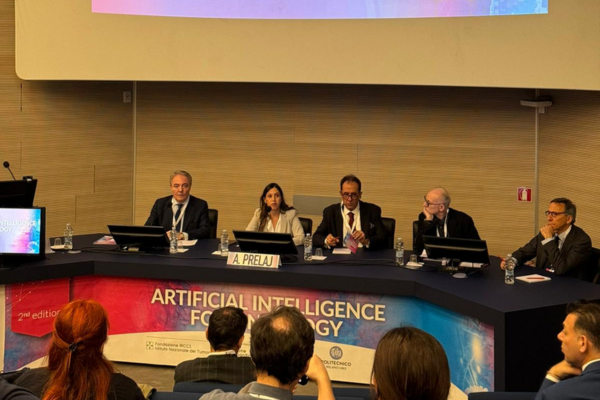
Arsela Prelaj, who is the coordinator of the Artificial Intelligence for Oncology (AI-ON) Laboratory at Fondazione IRCCS Istituto Nazionale dei Tumori di Milano, highlights that the most significant influence of AI is on diagnostics, specifically the processing of PET, CT, and magnetic resonance imaging. She also predicts that AI’s capabilities can propel oncology care into a data-driven era, also supporting treatment decision, and the efficient analysis and integration of the massive amounts of multi-omics data available for oncologists.
AI and Imaging in Oncology
Artificial intelligence (AI) advancements have dramatically changed the landscape of medical imaging, particularly in oncology. Session 2 of the conference focused on the practical applications and future trajectories of AI in imaging, with fascinating lectures including two from key members of the CCE Imaging Task Force, Raquel Perez-Lopez (VHIO) and Mireia Crispin (CRUK Cambridge Centre) on radiomics.
Dr. Crispin discussed the integration of radiomics into clinical practice, shining light on its critical function in cancer screening and diagnosis. Radiomics uses complex algorithms and machine learning approaches to extract quantitative data from medical images, allowing for more precise and early diagnosis of cancers.
Raquel Perez-Lopez then took the stage to share her knowledge on using radiomics for predictive analytics in cancer. She discussed treatment outcomes and toxicity, demonstrating how AI-driven radiomics can provide crucial insights into prognosis, assisting clinicians in developing personalized therapeutic regimens and reducing adverse effects.
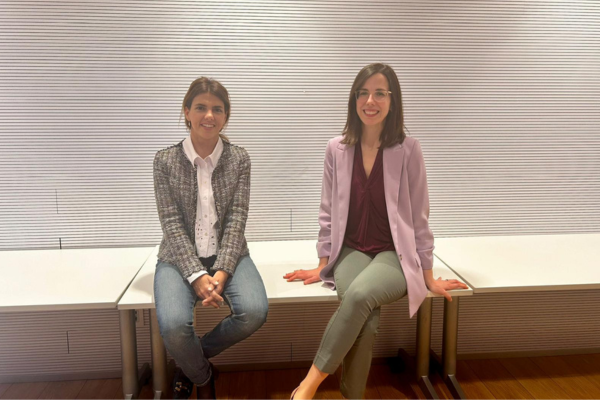
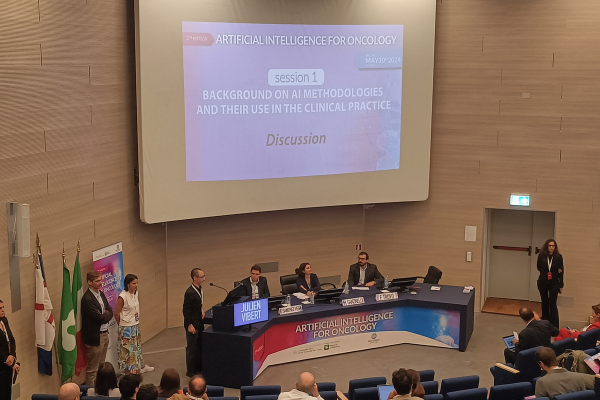
NCT Heidelberg-affiliated professor Jakob Nikolas Kather (Technical University of Dresden, EKFZ) also intervened in this session on imaging from the digital pathology field. He developed how the integration of cutting-edge AI approaches in pathology is fast becoming an important support for screening and diagnosis, but also for clinical decision-making.
These presentations demonstrated the revolutionary potential of AI and imaging technologies to reshape the landscape of oncological care, from diagnosis to treatment planning and beyond.
The event also gave space to the institute Gustave Roussy, another CCE member, with Julien Vibert (Drug Development Department), who offered valuable insights into the potential of deep learning for both genomics and transcriptomics analysis. Further, he demonstrated how this is already assisting clinicians in solving the very complex issue of identifying the source of cancers of unknown primary.
Empowering Oncological Research
As the field continues to evolve, the integration of AI promises to revolutionize personalized medicine, offering new avenues for improving patient outcomes and advancing our understanding of cancer. Cancer Core Europe is currently working on the design and launch of a task force dedicated to the integration of AI approaches to support its various pillars and research groups.
Consulted Sources:
Farina E, Nabhen JJ, Dacoregio MI, Batalini F, Moraes FY. An overview of artificial intelligence in oncology. NIH. 2022 Feb. doi: 10.2144/fsoa-2021-0074
Intelligenza Artificiale per l’Oncologia, nuove prospettive per diagnosi e terapie. Sanità Informazione. March 2024. https://www.sanitainformazione.it/salute/intelligenza-artificiale-per-loncologia-nuove-prospettive-per-diagnosi-e-terapie/
